Violet Moshe, 11 years old
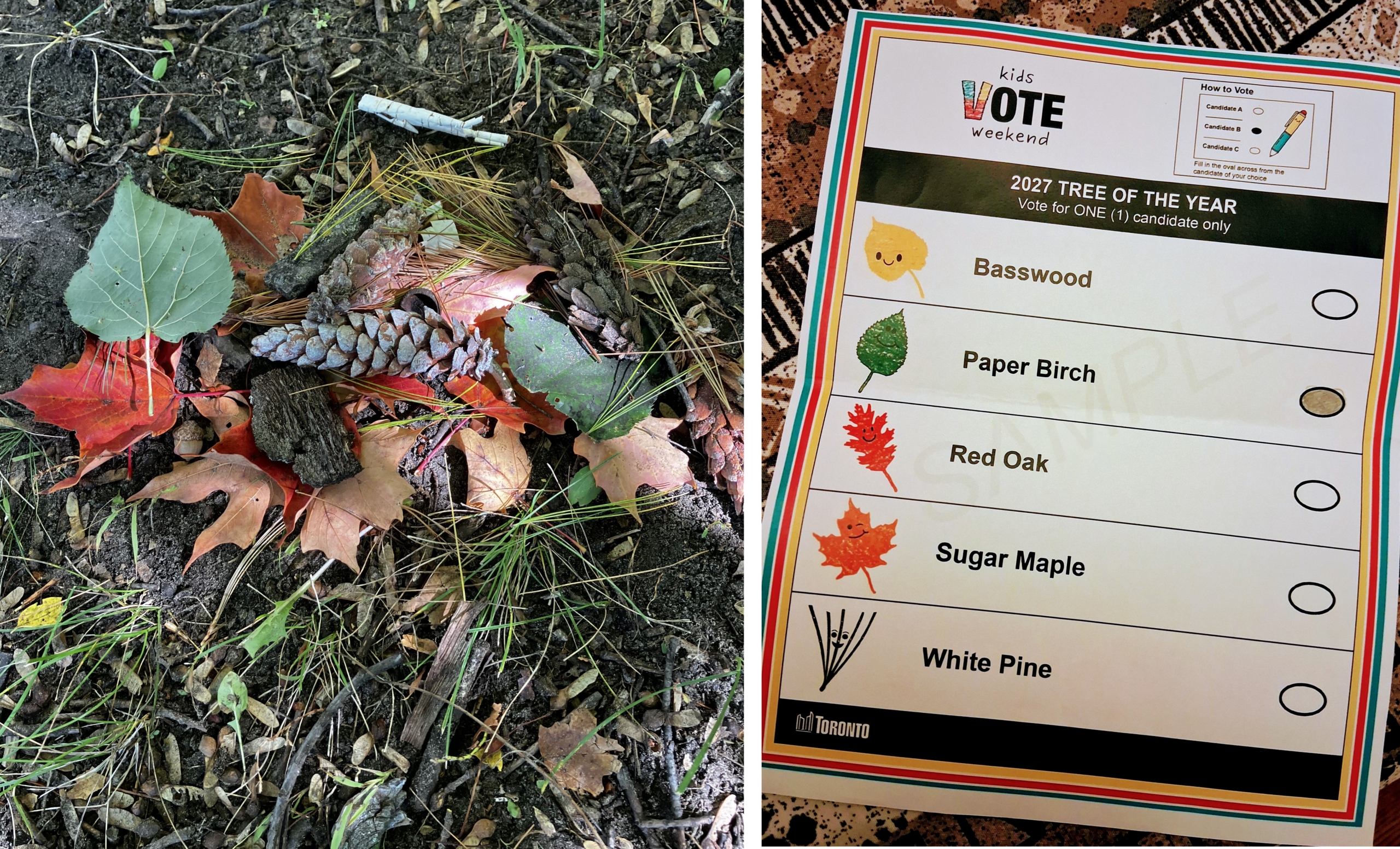
Did you know that on October 10th and 11th, kids all across Toronto voted for the 2027 tree of Toronto? The five candidates were basswood, paper birch, sugar maple, white pine, and red oak. One thousand of the winning species will be planted across Toronto next year.
Anne Purvis, the amazing leader of the TFN Juniors, and Maddie Trottier, a very engaging University of Toronto Ecology and Evolutionary Biology student, taught us about all five of the trees during our meetup at High Park a week before the elections. As we studied the five trees, we did leaf and bark rubbings for each type of tree, and collected samples for a mandala later.
First, we learned about red oaks. Guess how many species of caterpillars use red oak as a food source? 500!!! Also, various parts of oak can heal infections, wounds, and even sores in the mouth. To distinguish red oak from white, look at the leaves. If the leaves have round lobes, then it’s a white oak. If the lobes are pointy, then it’s a red oak. A good way to remember this is that if something pointy pokes you, you will bleed, and blood is red just like the type of oak. But wait, there is also a black oak, which has pointy leaves as well. Red oak leaves are wide and black oak leaves are narrow. One more thing you can do is to check the acorns. Red oak acorn caps only cover a small part of the seed, whereas black oak acorn caps cover most of the seed.
Next, we learned about white pine. A fun fact about white pine is that it originally came from a cold environment. Since it takes energy to produce new leaves each year, to conserve energy in a harsh climate it evolved as an evergreen: it has needles instead of leaves and keeps them on all year long. Another thing I found interesting about white pine is that its needles are high in vitamin C. There is 5 times more vitamin C in pine needles than in lemons. Isn’t that awesome?! If you ever want to identify a white pine, you should know that white pine needles grow in bunches of five. An easy way to remember this is that the word “white” has five letters just like the needles in the bunches of a white pine. In Indigenous tradition white pine is known as the tree of peace.
After that, we learned about basswood. A special thing about basswood is that it produces a huge canopy, so if it’s a hot day and you need some shade, you should try to find a basswood. The leaves of basswood are heart-shaped and asymmetrical at the base, with serrated edges. Basswood flowers are quite fragrant and make delicious tea. The flowers get pollinated by bees, and birds eat the berries that are produced. Indigenous people use basswood to make rope from inner bark, various parts medicinally, and they use wood to make ceremonial masks.
Then we looked at paper birch. Some things that we learned about paper birch are: paper birch has oils and waxes in the bark so it is water repellent and perfect for canoes. Animals eat paper birch seeds. Paper birch can be used to make paper, that’s where it got its name. Paper birch leaves have double serration, which means that not only does the edge look like a saw, but each little section is also a little saw. Anne also explained that birch is very flammable. And then she lit a piece of birch bark so we could see!
Lastly, we have the sugar maple. I was surprised when I found out that the sap of a sugar maple is 3-6% sugar which is much more than other types of maple. A samara is a special type of dry, winged fruit produced by maple trees which holds maple seeds. I remember that when I was younger, I would throw samaras up in the air and watch as they twirl their way down. We called the samaras helicopters.
At the end of our meeting the kids used fake ballots to place their votes for a mock election and it was announced that paper birch was the winner. The one I voted for! I think (hope!) that it will win the real election, but until the results are released on October 26, I guess we’ll just have to wait and see.