On Nov 12th, eight TFN Jrs families gathered at ‘The Hub’ at Downsview Park for a wonderful workshop of ‘Owl Pellet Dissection’. Our morning kicked off with an informative slideshow about Owls created by Maddy Trottier. We learned that there are eleven owls to be found in Toronto, but only two of them are resident–the Eastern Screech Owl and the Great Horned Owl.
Maddy explained to us that a niche is somewhere a creature belongs because of special abilities. Owls fill two niches. The first is ‘Nocturnal’–they are active at night, and sleep during the day. Owls see well at night because their eyes have more rod cells, which are effective in dim light. The second is the wing structure. The barbs of the flight feathers are all separated, so that the wing edge is broken up in flight. This causes it to move less air, therefore create less turbulence and fly silently. We tried fanning ourselves with our fingers together and apart, to demonstrate this characteristic. It worked!!
The second niche Owls fill is that they are Predators. The first special ability that allows this is reversible talons. They can move a talon from a perching arrangement to a ‘two forward, two back’ arrangement for grasping prey more effectively. They also have a remarkable digestive system, in which they swallow prey whole. In the first stomach they digest all the meat off the bones. In the second stomach they create a ‘pellet’ of all the indigestible fur and bones, for regurgitation.
The Downsview staff person, Lucky, brought in a stuffed Snowy Owl for us to examine. We could see the reversible talons and the edges of the flight feathers broken up for silent flight.
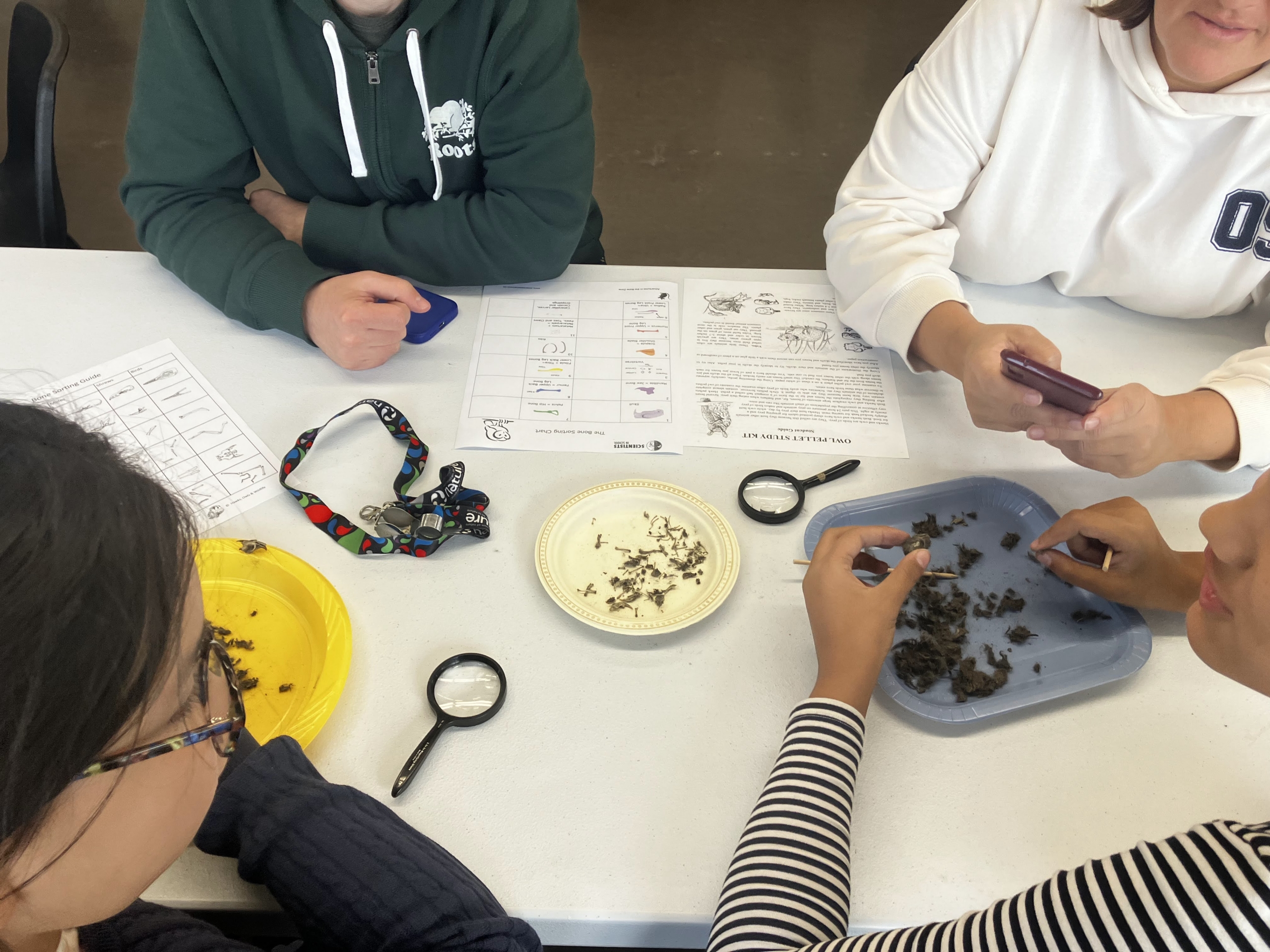
Our project of the morning was to take apart an Owl pellet. The participants worked in pairs, each person extracting the bones from half of a pellet. Some of the bones were easy to handle–such as the skull and the upper leg and arm bones. Others were very slender, and harder to handle, such as ribs and claws. We cleaned away the fur from the bones using a shish-kabob stick. It turned out all of our skulls had the long orange teeth of a rodent. So we didn’t find the remains of any shrews or moles.
Once we had cleaned all the bones, we sorted them on a chart that provided the names of the bones. This allowed us to identify the corresponding bones in our own bodies! Then we re-assembled the skeleton of the prey, by pressing it into plasticine rolled out on a paper plate. Each participant was able to take home a rodent skeleton as a souvenir of the workshop.
Thanks to Maddy, Georgia, Lucky, Marina, and Jim for providing all the assistance needed and helping everyone to have such an exciting morning.